

“What kind of work excites you?,” I asked.
“I’m not sure. I like it all,” she responded.
“But what if you had to choose something?” I gently pushed.
“I really don’t know,” she insisted.
“OK,” I said, realizing that this question wasn’t landing. “How about we look at it this way? What do you hate doing?”
“There is nothing I really hate doing.” It was – most likely – the first time that I had ever heard that response to that question. The “What do you hate doing?” question usually opens the floodgates on the conversation. Not this time, though.
The call went on for another 45 minutes or so. During that time, I introduced this woman to the Eisenhower Matrix. It’s likely that you have come across it in your travels. It helps us to prioritize items that we have on our to-do list, using the distinctions of urgent and important. The graphic below is what I share with my clients because it is the simplest and most action-oriented I have seen.
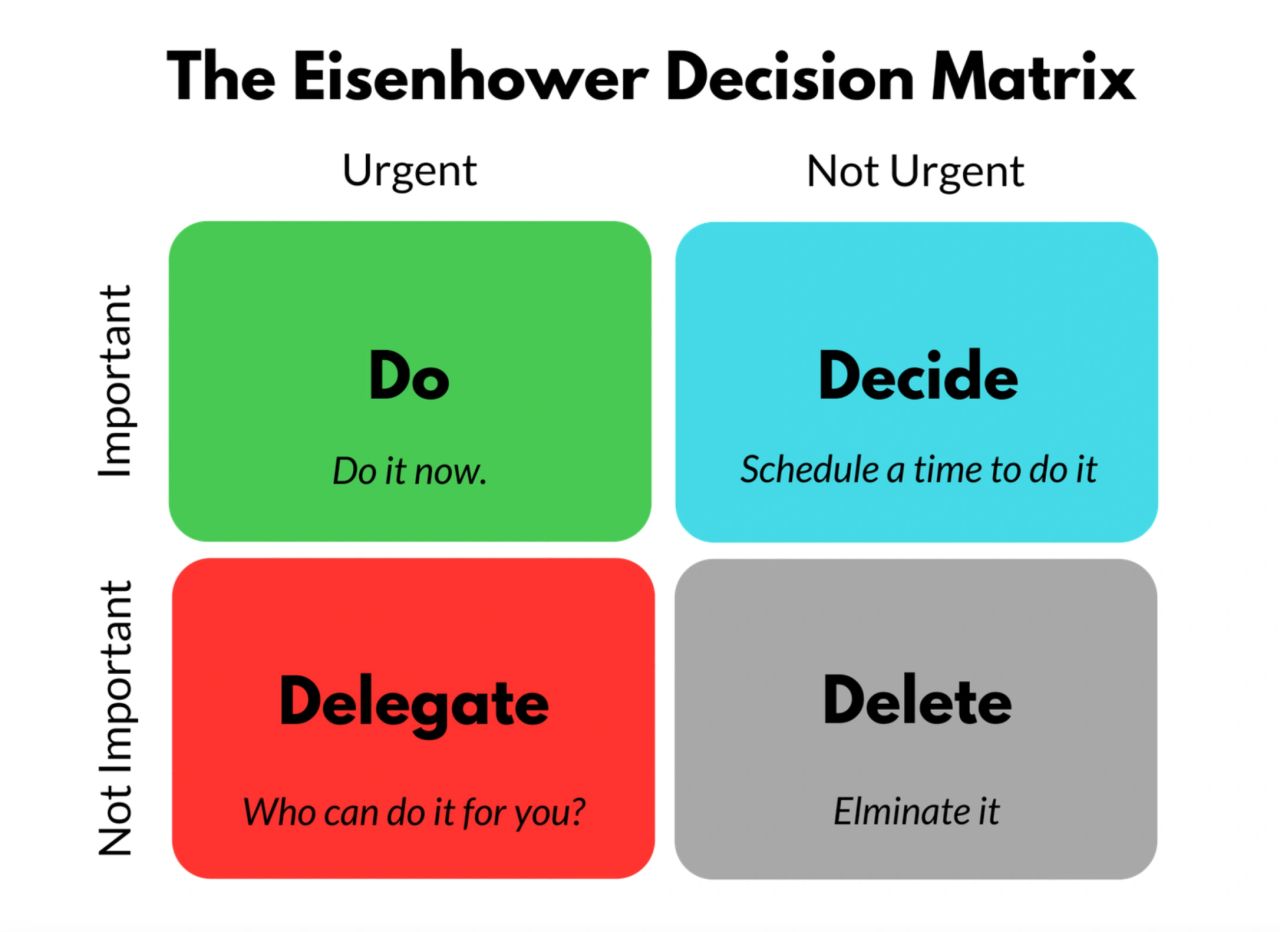
Taken from Luxafor.com
She appreciated this framework, but shared that she wasn’t sure what was most important. The tool was great, but the criteria is what she needed help with. Something that I see often in working with leaders is the blurring of what is important versus what is urgent. The immediacy that permeates our society has made it difficult to differentiate between what needs to be done and what we think needs to be done. That’s a subtle distinction with an enormous difference. The philosopher in me loves this!
Important things are those that move the organization forward to achieving its goals. Urgent ones are those that appear or seem to require our attention, but it’s questionable – at best – on whether or not they help an organization to move forward. When I start working with most leaders, it’s common to see them running from fire to fire when the most important actions of working on the business (i.e. creating strategy, communicating vision, meeting with their senior leaders, developing succession plans, etc.) are neglected. And here’s the thing, if everything is urgent then nothing really is.
I was having a conversation with my own coach about the concept of urgency. I was sharing how I had observed one of my clients behaving in a manic way, running from one thing to the next. I was telling that story to make another point, but she, rightly, stopped me in the middle. “Urgency is created,” she said. “It only seems urgent because we tell ourselves it is.” I thought about it for a minute. She was right. Our mind is a powerful thing, and when we attach ourselves to the notion that something has to be done, we start feeling anxious because of that urgency. Let’s face it, we can live our lives like a car is coming right for us while we are sitting in front of our computer reading an email. One actually does require swift action, and the other may make us feel like we need to act swiftly to please the person on the other end, get it off our desk, or feel like we are accomplishing something. Are we really doing any of that, though?
Permit me a story to illustrate. Before I started my coaching practice, I worked in the automotive industry. If you have never worked in that industry before, you’ll have to trust me when I say that it has no concept of the distinction between the urgent and the important. Every month is life or death. Every customer is make or break. You get the idea.
While working as a Sales Manager, I recall going into managers meetings and the focus would be on one key metric that we needed to improve immediately. The next day an email would come out with another metric that needed to be improved immediately. Can you guess what happened next? Another directive would come out with another metric that needed to be improved immediately. Here’s the thing, it made it difficult to figure out what to actually focus on. It created unnecessary anxiety inside of the management team and throughout the department. It caused confusion because we weren’t sure which of these increasing number of metrics was actually the one that mattered most to drive the business forward. As you may imagine, turnover was really high in this particular company. Shockingly, they had great results. Until they didn’t. Here’s the thing, our fight-or-flight systems can be engaged for a while, but eventually, they always give out on us. We get sick. We get tired. Then we get sick of being sick and tired.
Now you may be reading this, having already acquiesced that this is just how business is. Not so fast. There is an easier way to create clarity and alignment around what is important. There is a way to push back against the tyranny of the urgent in order to reap the rewards of compounding momentum. There is a way to create predictable results that isn’t waiting for the economy to improve, world conflict to cease, or a myriad of other external factors we think will change our outcomes. How do we turn off autopilot and operate our organizations with purpose?
As is usually the case, the answer is in the question. What is the purpose of your organization? What kind of world is your organization creating? Why is the world different because your organization exists? This appears to come easier to non-profit organizations and faith-based organizations. Just because they have to dig a little deeper, though, it doesn’t mean that for profit organizations lack purpose. Consider Apple, Starbucks, Google, and Meta who all sell products, yet their mission statements describe something far beyond buying a phone, a cup of coffee, information, or a virtual relationship. They talk about enriching lives through technology, information, and fostering connection. They act as a guide, not only for executives, but for everyone. Through each interaction, the Starbucks Baristas are fostering connection. That’s why the new CEO, Brian Niccol, is bringing back the sharpies for baristas to write a guest’s name on their coffee cup. He believes this is a key element in living out the company’s mission. This signals two things: (1) that well-crafted vision, mission, values, and goals clarify what’s important, and (2) well-run companies model and communicate these through action.
When I hear a complaint about performance from a leader in an organization, I always ask them three things:
1. What does success look like for this person?
2. How does their job move the company forward?
3. Do they know these things?
It’s common – at the beginning of my work with an organization – for that leader to be unclear on the answers to the first two questions. As a result, it makes it really difficult to answer the third one. If a CEO or business owner isn’t clear on what success looks like for their organization, then everyone is just doing what they think is right in their own eyes. As my coach often reminds me, our results are always perfectly suited to our current systems. If a leader finds a lack of clarity, alignment, and focus in their organization, it’s because the system lacks purpose, alignment, and focus.
Earlier this week, I was having lunch with one of my clients. We were talking about our annual planning session coming up and I asked what he hoped we would accomplish through it. “I think it will be great for [employee names] to hear about the vision of the company, where we are trying to go, and how we need to structure the company to get there.” He understands that “singular vision and collective purpose” align an organization, shining a light on what’s important. I’m eager to see the remarkable results that await in 2025 with this type of focus.